
Tips On Running Payroll For Restaurants

Running a restaurant is notoriously difficult. Between low profit margins, high food costs, and endless overhead expenses, it’s challenging to earn enough revenue—especially when you factor in payroll.
Payroll often accounts for approximately 30% of a restaurant’s expenses, and that’s even when tips are factored in.
That’s why it’s so important to understand payroll for restaurants. The nuance between state and federal law could spell the difference between shelling out hundreds or thousands of extra dollars every month to your front-of-house workers.
And making mistakes could be costly. Examples:
- Fast food company Jack in the Box ran payroll with a fraction-of-a-penny error for all Oregon paychecks over eight years, and it ballooned into more than $5 million in penalties.
- A pizza shop in Minneapolis paid more than $100,000 after multiple violations, including not combining employee hours worked at multiple locations, improper tip pooling, and failing to pay overtime.
- A Pittsburgh restaurant allowed managers to participate in the tip pool, which led to $184,000 in back wages, damages, and penalties via the U.S. Department of Labor.
Continue reading to learn more:
Understanding Payroll For Restaurants
Here are some of the most important legal requirements and best practices to know as a restaurant owner or manager:
Tipped Wages
As an employer, you’re responsible for ensuring your tipped employees earn at least minimum wage for each pay period. Because tips can fluctuate, you may occasionally be legally required to pay more than the base cash wage, which we’ll explain below:
Minimum Wage
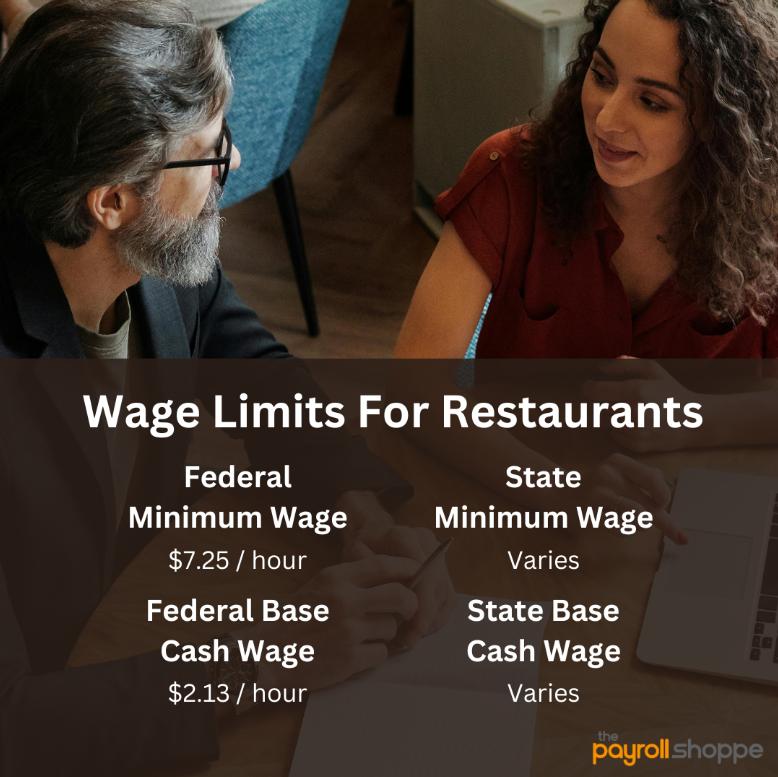
As an employer, you must abide by two separate minimum wages—the federal minimum wage and your state minimum wage, and you must pay your workers whichever is higher.
The current rates to keep in mind (as of July 2026):
- Federal Minimum Wage: $7.25/hour
- State Minimum Wage: Varies (In Pennsylvania, for example, the state minimum wage matches the federal minimum of $7.25 per hour. Washington state, meanwhile, currently has the highest minimum wage with $17.13 per hour.)
Base Cash Wage
Workers who earn most of their income through tips are allowed to earn a smaller base wage from their employers, as long as it still meets the required minimum wage when combined with their tips.
Base wages to keep in mind:
- Federal Base Cash Wage: $2.13/hour
- State Base Cash Wage: Varies (In Pennsylvania, for example, the base cash wage is $2.83 per hour.)
So, for example, say a waiter at your restaurant in Pittsburgh works 35 hours and earns $1,000 in tips. On their next paycheck, you would pay $99.05 (35 hours X $2.83 state base wage) before removing taxes and benefits for $1,099.05 ($1,000 + $99.05).
Tips to Minimum
You may occasionally be required to pay more than the base cash wage to ensure your employee receives minimum wage—a practice known tips to minimum.
Getting back to our example: Let’s say that same waiter worked 35 hours but only earned $100 in tips over that period. Combined with the $99.05 base rate, they would receive $199.05. However, federal and Pennsylvania minimum wages require them to earn at least $253.75 ($7.25 per hour X 35 hours) in that time period.
In this example, you would be responsible for paying an extra $54.70 ($253.75 – $199.05) to ensure your employee earns minimum wage.
Split Shifts
Split shifts are common in the restaurant industry, especially when a restaurant may close for a few hours during the day, like between the lunch rush and dinner. During a split shift, an employee might work for a few hours at lunch, be off for a few unpaid hours, then return for the dinner hours.
Split shifts come with a few legal requirements:
- The employee must be off for at least two hours.
- Occasionally, the employee must receive extra pay. This isn’t required on the federal level, but it’s sometimes required on the state level, like in California.
Reporting Cash & Credit Card Tips
Under federal law, 100% of tips must be reported—and your employee must report those tips to you if they earn more than $20 in tips in a single month.
Although it’s common for restaurant workers to underreport their cash tips, this could ultimately backfire—and not just if they’re ever audited. Inaccurate tip reporting could hurt employees if they:
- Try to apply for a loan, like a mortgage.
- Want to get approved for an apartment.
- Need to receive adequate unemployment benefits if they ever lose their job.
Federal law is also clear about reporting during a tip-out policy—when tips are split with bussers, hostesses, bartenders, and other front-of-house staff: Only report on what you retain.
Find Payroll Support for Your Restaurant
If running payroll feels like one more headache in running your restaurant, contact us.
Our deep experience in the restaurant industry simplifies everything payroll-related, including complicated Time & Attendance practices.
Our hands-on, customer service-driven team is standing by!