
How to Do Payroll For A Construction Company: 3 Hidden Challenges

Article Summary: Construction is an exciting, fast-paced industry, but it’s packed with regulatory risks. That’s why it’s so important to know how to do payroll for a construction company. Issues with worker classifications, union regulations, overtime requirements, and other mandates could result in fines, audits, and more. Continue reading to streamline your company’s payroll processes.
Running a construction company is already difficult enough. You’re responsible for the physical safety of your entire team, hitting tough deadlines, and working in dangerous conditions.
All of those are physically challenging, but they’re not nearly as difficult as maintaining accurate payrolls.
The construction industry is rife with classification issues, complex union regulations, layered state and federal laws, and confusing overtime requirements.
One slip-up could open you up to audits, fines, and more.
Read on to learn the secrets behind how to do payroll for a construction company—and know exactly what to watch out for.
How to Do Payroll For A Construction Company: Hazards to Watch
If you want timely, accurate payrolls for your construction company, watch out for the hazards. While payroll processing seems like it should be easy, the legal and organizational complexities of the construction industry create multiple hazards to overcome.
Here’s what to watch for:
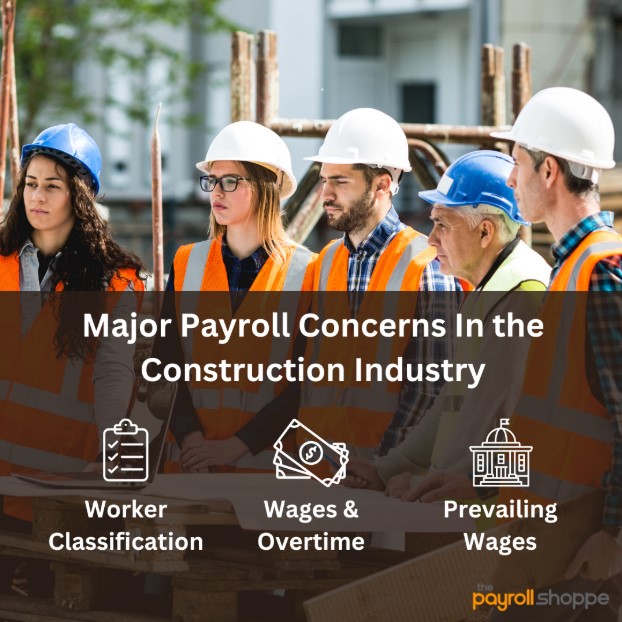
1. Worker Classification Issues
Worker classification is a constant headache for construction companies, and the proof is in the headlines. A few recent cases:
- In December of 2025, a DC construction company agreed to pay $1.5 million for misclassifying hundreds of workers.
- Last summer, a Massachusetts construction company was hit with a $744,224 fine for misclassifying workers and forcing them to miss overtime, sick time, and other benefits.
- In the summer of 2023, a North Carolina construction company was fined $1.6 million in a DOL misclassification lawsuit.
There’s a constant temptation to categorize every construction worker as an independent contractor. After all, employees require:
- Minimum wage concerns
- Overtime wages (when appropriate)
- Federal, state, and local taxes
- Employee benefits, retirement, and fringe benefits
- Worker’s compensation
By the time you cover everything else, you’re paying 25%–40% more than the employee’s salary. That’s one reason why nearly 2.1 million construction workers are misclassified or paid off the books.
As tempting as it is to make these workers independent contractors, the DOL and IRS have stringent rules and penalties for misclassification.
2. Wages, Overtime, and Regulations
As we mentioned earlier, payroll is already complicated enough. But as we factor in overtime, meals/rest breaks, and leave requirements specifically in construction, it all becomes more complicated.
The reason: skills, pay scales, job site location, and union requirements.
A construction worker who swings a hammer in the morning, operates a forklift before lunch, and controls a crane in the afternoon could potentially earn three different hourly wages in the same day.
That’s a payroll accuracy nightmare, and it’s why documentation and robust Time & Attendance software and tools are so important.
3. Prevailing Wages
If your company ever manages public projects, you’re subject to prevailing wage requirements—which are minimum wage rates based on your location.
This is the direct result of:
- The Davis-Bacon Act of 1931, which outlines prevailing wage requirements for federal projects. Under the Act, you could face damages equal to the underpaid wages. So, if you accidentally underpaid workers by $25,000, you’d have to pay them their wages and a fine of $25,000.
- State prevailing wage laws. Twenty-six states—Pennsylvania included—have their own prevailing wage laws with their own unique penalties and requirements.
Another important note: These wage laws only kick in for projects of a minimum size, but that minimum can vary. In California and Rhode Island, that minimum is $1,000. In Colorado, the minimum jumps all the way to $500,000.
To maintain complete compliance with prevailing wages, focus on creating thorough certified payroll reports. Remember: These reports must be filed with the U.S. Department of Labor every week! Learn about Form WH-347 to get started.
The Cost Of Construction Payroll Non-Compliance
As we mentioned earlier, non-compliance is dangerous. Your mistakes could:
- Trigger stressful audits with the DOL, IRS, or state agencies
- Attract significant fines
- Lead to embarrassing employee complaints (which could attract auditors)
- Damage your public reputation
Some of the penalties you could face:
- Misclassification: Misclassification fines vary by the enforcing agency, but you’re also subject to backpay, back taxes, and more. Obviously, it’s not uncommon to see these cases exceed $1 million!
- Davis-Bacon Act: As we mentioned earlier, the damages are often equal to the amount you underpaid your workers, at least on the federal level. State agencies may have different rules from the federal level.
- Form WH-347: While fines are possible, so is imprisonment for false certification.
Obviously, construction payroll is dangerous to get wrong. But we can help.
Find Payroll Support For Your Construction Company
Don’t leave construction payroll accuracy to chance.
Contact us for support. Our experienced team will ensure you receive the dedicated support you deserve—with total accuracy.