
How to Comply With PA Act 32

Article Summary: PA Act 32 was meant to reduce the number of state tax collectors and streamline EIT withholding. Unfortunately, some areas of the state, like Allegheny County, are more difficult to understand than others. Read our full article to understand how to comply with PA Act 32 and its potential penalties.
When Pennsylvania Governor Ed Rendell signed PA Act 32 into law back in 2008, it was designed to streamline local taxes by reducing the number of state tax collectors and requiring employers to withhold EIT from each paycheck.
The intent was good, but it’s been a nightmare for employers in our region.
In addition to withholding EIT, Allegheny County employees must also contend with four different districts in the county, creating multiple opportunities for mistakes throughout the year.
Continue reading to learn everything you should know about PA Act 32 and remaining compliant in all payroll operations.
Understanding PA Act 32
What Did Act 32 Do?
Act 32 created new tax collection districts and requirements across Pennsylvania, resulting in 69 districts that mostly matched the 67 counties in the commonwealth, with two big exceptions:
- Philadelphia was not included because of the Sterling Act (a 1932 law that gave Philadelphia greater rights to impose its own taxes).
- Allegheny County was split into four districts.
Splitting Allegheny County into four separate districts has created headaches for Pittsburgh-area business owners aiming to remain in compliance with state law, which is why complete payroll services can be so valuable.
What Are the Act 32 Requirements?
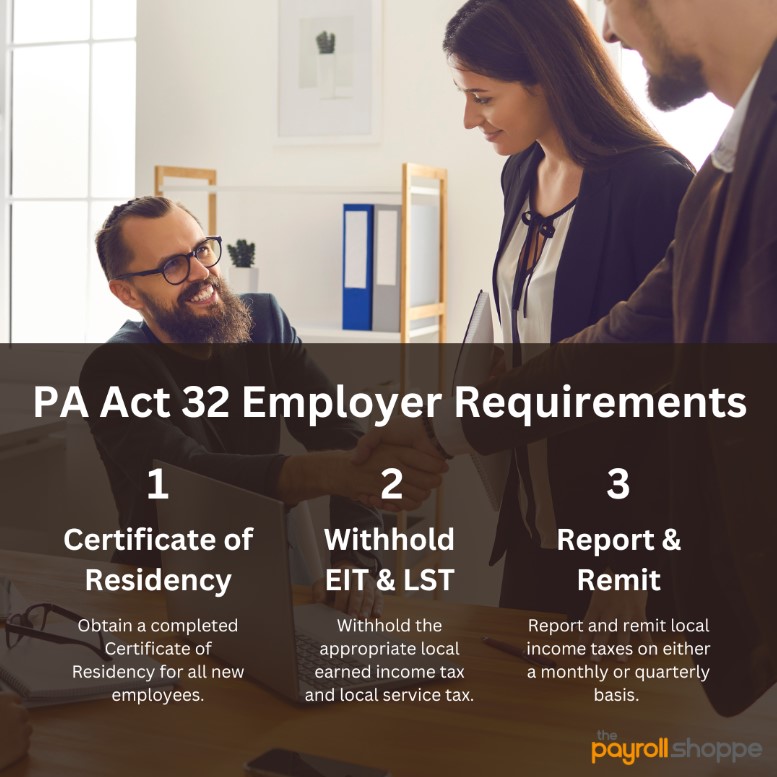
PA Act 32 outlines three major requirements for employers to follow. They must:
- Obtain a completed Certificate of Residency for all employees when they begin working and go through your hiring and onboarding process.
- Withhold the appropriate local earned income tax (EIT) and local service tax (LST) from all PA employees.
- Report and remit local income taxes on either a monthly or quarterly basis.
What Happens If You Don’t Follow Act 32?
Non-compliance could result in significant penalties. A few of the potential enforcement measures:
- You could be forced to make accelerated payments, essentially paying on a monthly basis instead of a quarterly basis.
- You could be responsible for all collection and legal costs if a tax collector is forced to take legal action against your company.
- You could face penalties and interest for unremitted taxes, sometimes as high at 5% per month!
What Are the Tax Rates I Should Follow For PA Act 32?
The Pennsylvania Department of Community & Economic Development outlines:
- PSD Codes & EIT Rates
- Details on Local Income Tax Collectors
If you’re in Allegheny County, below are the local governing bodies that monitor for accurate tax rates:
|
District |
Tax Collection Agency |
Address |
Phone |
|
Allegheny Central Tax Collection District |
102 Rahway Road, McMurray, PA 15317 |
412-835-5243 |
|
|
Allegheny North Tax Collection District |
546 Wendel Road, Irwin, PA 15642 |
724-978-0300 |
|
|
Allegheny Southeast Tax Collection District |
546 Wendel Road, Irwin, PA 15642 |
724-978-0300 |
|
|
Allegheny Southwest Tax Collection District |
102 Rahway Road, McMurray, PA 15317 |
412-835-5243 |
This level of variety on the local level makes Act 32 compliance in Allegheny County especially challenging.
For example, an employee living in Monroeville, working in Pittsburgh, and moving to Bethel Park during the year can trigger multiple tax-rate and PSD-code changes. Without proper payroll procedures, you could easily withhold the wrong amount and create compliance issues.
Find Hands-On Compliance Support for PA Act 32
Don’t get taken by surprise! Rely on our team for full tax compliance.
In addition to fewer headaches, you may also find what so many business owners have already discovered: Outsourced payroll is less expensive than running it yourself!
Contact us today to get started.