
Understanding Employee Garnishments: What to Do When You Receive An Order

Garnishing an employee’s wages is an awkward responsibility. But when a garnishment order crosses your desk, you don’t have a choice.
Unfortunately, most garnishment orders don’t come with step-by-step instructions on how to remain compliant.
Instead, it’s up to you to evaluate each variable and accurately garnish the proper amount on each payroll.
To help, we’ve outlined the nuance at each step. Continue to reading to learn more.
Table of Contents
What to Do When You Receive An Order
Calculating Garnishments
Here’s everything you need to know when it comes to calculating garnishments for your employees:
Understanding ‘Disposable Earnings’
A critical part of understanding garnishment calculations is understanding the definition of “disposable earnings”—earnings that can be legally garnished.
In general, disposable earnings are what’s left in the paycheck after taxes, social security, Medicare, unemployment, and retirement (if required by law) are applied.
Any amount that is elective—such as union dues, health insurance, life insurance, or a voluntary retirement plan—does not reduce an employee’s overall “disposable earnings.”
Calculating ‘Ordinary’ Garnishments
An “ordinary” garnishment is any garnishment that doesn’t touch child support, bankruptcy, or state/federal taxes.
According to the Wage And Hour Division of the Department of Labor, weekly garnishments may not exceed the lesser of two figures:
- 25% of the employee’s disposable earnings
- The amount by which an employee’s disposable earnings are greater than 30 x the federal minimum wage.
To see this in action with simple math, say an employee receives $1,000 in disposable earnings each week. We’d arrive at two numbers:
- 25% of $1,000 = $250
- Earnings Greater Than 30 x $7.25 ($217.50) = $1,000 – $217.50 = $782.50
In this case, weekly garnishments may not exceed $250 (the lesser amount).
View the Wage And Hour Division’s chart for more information.
Additional Rules & Exceptions
Some garnishment rules vary under certain circumstances. For instance:
Child Support
Child support garnishments exceed our previous limits. The current rules:
- 60% of disposable earnings can be garnished if the employee is not supporting another spouse or child.
- 50% of disposable earnings can be garnished by the employee is supporting another spouse or child.
- An additional 5% can be applied for support payments more than 12 weeks in arrears.
Student Loans
Rules for the U.S. Department of Education and past-due student loan payments are a little different. Garnishments here can go up to 15% of disposable earnings.
What to Do When You Receive An Order
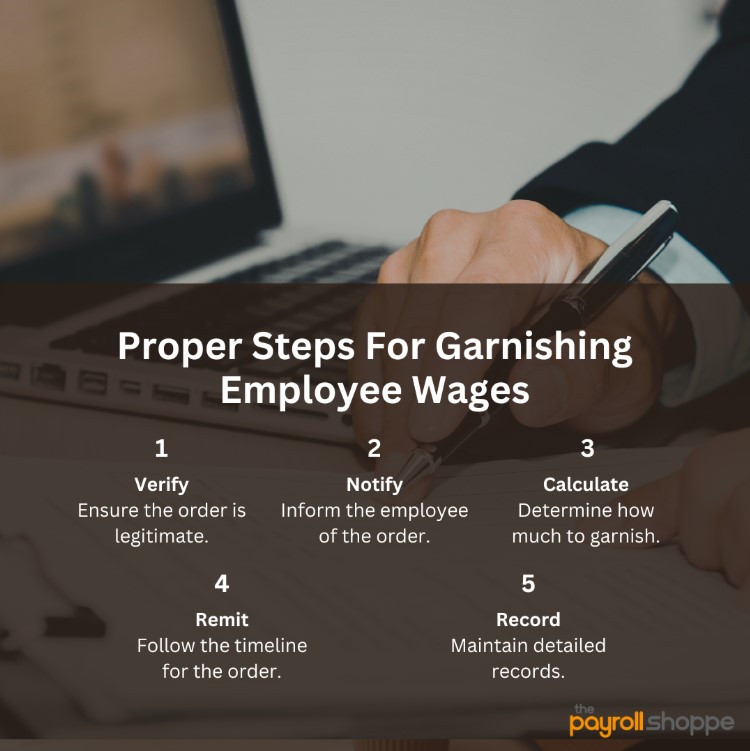
If you receive a garnishment order—don’t panic. Contact us for support, or use this five-step action plan:
- Verify the Order’s Legitimacy – Your first step is always to ensure the order is a real, legitimate action to avoid fraudulent payments. Call the office directly using a publicly listed phone number—which may or may not coincide with the contact information listed on the order.
- Notify the Employee – Notifying the employee is often an uncomfortable step, but it’s a critical measure to avoid additional issues later on. At a minimum, provide the employee with a copy of the paperwork.
- Calculate Limits – These calculations can be tricky, as there are multiple variables once you understand the employee’s “disposable income.” Revisit our calculations section for more information.
- Remit Payments – The order should outline a specific timeframe for garnishments. Be sure to comply with the order, and send funds directly to the agency or creditor.
- Maintain Record – Keep all documentation to prove compliance.
How to Prioritize Garnishments
The Wage And Hour Division of the Department of Labor does not have provisions outlining garnishment priorities. Instead, these are determined by other state and federal laws—which means priorities may shift by location.
And that’s where the confusion begins. Occasionally, you’ll receive multiple notices at once—which can be common when an employee is facing divorce and other legal/financial issues at the same time.
In these circumstances, the general priority list is:
- First Importance: Child Support
- Second Importance: Tax Levies
- Third Importance: General Creditors
Of course, you always double-check regulations to ensure you remain in compliance.
Find Additional Garnishment Support
You don’t need to manage complicated garnishment orders on your own. Contact us for professional support that delivers accurate payroll.
Our team is standing by and ready to deliver the help your company needs!