
W2 or 1099 Employee? Clarity On A Complicated Topic

One of the worst mistakes we see companies make in their Payroll over and over again isn’t tax errors, overtime accuracy, or timekeeping.
It’s misclassification. In fact, the biggest error we hear employers admit to is, “I’ll just make them a 1099.”
Making someone a true independent contractor isn’t something you can do with simple paperwork. Payroll compliance is much more complicated than that.
Read on to learn everything you need to whenever you’re asking, “Is this a W2 or 1099 employee?”
Review Our Employee-Independent Contractor Checklist
The DOL and IRS both have stringent requirements on what makes someone an employee or contractor. As a refresher, the Department of Labor and Fair Labor Standards Act focus on six factors:
- Profits/Losses: If the individual can impact your bottom line, there’s a good chance they’re an employee.
- Capital Investments: Do you ever pay for the worker’s tools, like laptop and software access? If so, they might be an employee.
- Permanency: How long do you expect this relationship to last? If it’s an indefinite engagement, it could qualify as traditional employment.
- Control: Who has control over how the work is performed? If you dictate the worker’s strategy, technique, and other factors, you could cross the line into an employer-employee relationship.
- Necessity: If you lost the individual and their work tomorrow, would it negatively impact your business? If so, you could have an employee at your company.
- Skills & Planning: Do you determine the professional’s training, work, and vacation schedule? If you want that level of oversight, be ready for another employee.

As we explained in Your ‘Employee Or Independent Contractor?’ Checklist, 3.4 million workers are likely misclassified right now, according to the Economic Policy Institute. That’s nearly 2.1% of all workers in the United States!
Don’t make the same mistakes. Protect yourself—and your company—with knowledge.
Tax & Accounting Differences Between An Employee and An Independent Contractor
We have a secret: There’s a mistake in our blog title.
Did you notice it?
Even though we’re often asked, “How do I know if someone is a W2 or 1099 employee?” there’s actually no such thing as a “1099 employee.”
A true 1099 recipient is an independent contractor, someone who operates as their own business.
Here’s how the paperwork breaks down for employees and independent contractors:
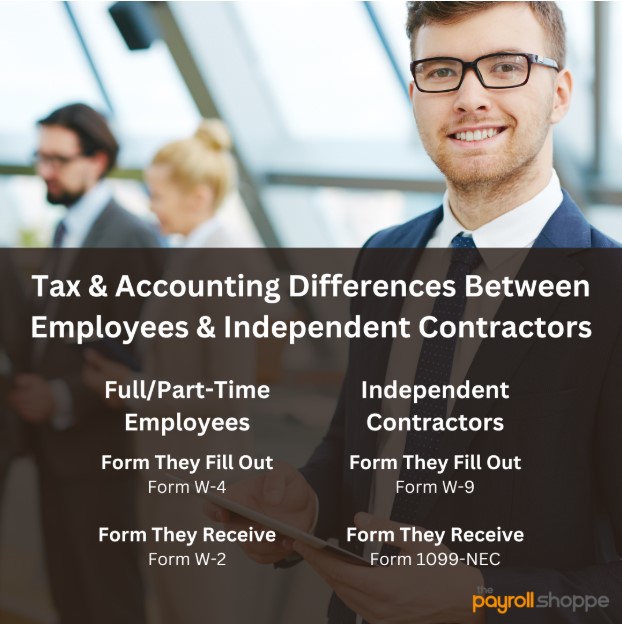
Employees
Independent Contractors
When Hired, They Fill Out: Form W-9
At Tax Time, They Receive: Form 1099-NEC (Note: In some cases, an independent contractor
Related Reading: Your Critical Year-End Payroll Checklist
Employee Misclassification Penalties
The penalties for misclassifying a “W2 or 1099 employee” can be harsh and swift, and they’re not limited to financial repercussions. Here’s what you could be on the hook for:
Tax Penalties
Misclassification errors can turn into costly tax penalties, including:
- 100% of FICA (Federal Insurance Contributions Act) taxes that weren’t paid to support Social Security and Medicare
- Up to 40% of the taxes you failed to withhold from the employee’s wages
- $50 per W-2 you didn’t file for each misclassified employee
Let’s examine this with some simple math. Say you paid a contractor $100,000 over the course of a year. Between FICA, withholding, and the W-2 penalty, you could be on the hook for $23,350 just for that one worker.
And that doesn’t include interest, state-level penalties, or wage/hour law violations.
FLSA Violations
FLSA violations can turn into costly line items as well:
- Backwages, including unpaid overtime and taxes on those backwages
- Penalty of $1,000 per misclassified employee
- Benefits insurance, which may include paid leave, pension payments, workers’ compensation, and more
In more severe cases, you could also face jail time for a full year and class-action lawsuits for punitive damages and attorney fees.
Reputational Damage
Not all damages are financial. Your reputation could take a huge hit—and in more ways than one. You could suffer:
- Lost trust with customers
- Lost trust with employees
- Lost trust with contractors
- Lost trust with potential employees
- Lost trust with potential contractors
- Lost trust with potential customers
All of your relationships could suffer from misclassification, and these ramifications can have a long-lasting impact.
New 1099 Limits In the One Big Beautiful Bill Act
Keep Payroll and Accounts Payable on alert: The reporting threshold for 1099s just increased, thanks to the One Big Beautiful Bill Act becoming law on July 4, 2025.
In 2026, the threshold for reporting jumps from $600 in a calendar year to $2,000 in a calendar year—and then it’s indexed for inflation starting in 2027.
That’s good news, as it could ease some of the reporting burden for your team.
Find Payroll Accuracy—And Support
Don’t let dreaded “W2 or 1099 employee” misclassification issues damage your business. Work with our experienced team at The Payroll Shoppe.
Contact us to learn how we can streamline payroll and help prevent misclassification problems. Worried about timing? Read our guide on Switching Payroll Providers Mid-Year.