
Which Business Structure Is Right For You? Understanding the Nuances of Payroll

Whenever we meet a prospective client, one of the first questions we ask is, “How is your company set up?” Inevitably, this leads us into a long conversation about sole proprietorships, LLCs, S-Corps, and much, much more—especially when it comes to their payroll impact.
Here’s why: Every business structure has its own inherent legal protections and tax benefits for the owner, but it also has serious payroll implications that could potentially simplify or complicate your payroll.
Know what’s best for you and your company. Read on to learn the payroll benefits of different business structures.
Table of Contents
Payroll Benefits of Different Business Types
FAQs: Which Business Entity Is Right For You?
Note: Determining how your company is set up is a complex question, and we recommend discussing your unique business needs with a CPA.
Payroll Benefits of Different Business Types
Here are some of the advantages and disadvantages of running your business through different legal structures:
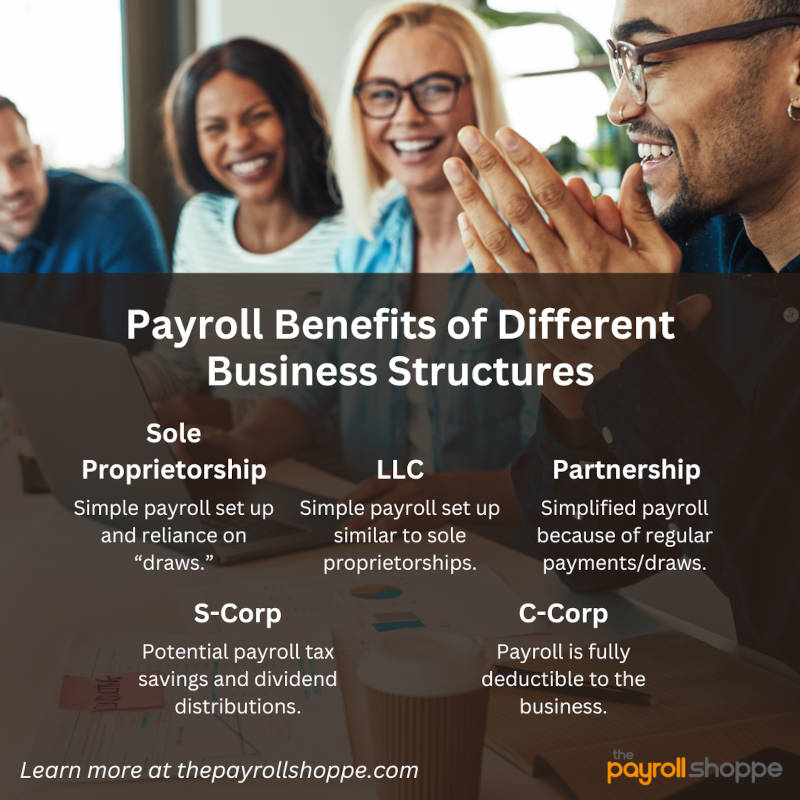
1. Sole Proprietorship
A sole proprietorship is the simplest and most common business structure. In fact, some estimates say there are around 30 million sole proprietors in the US! A sole proprietorship is an unincorporated business owned and operated by one individual, which means there is no legal distinction between the owner and the business.
Potential Payroll Benefits:
- When a sole proprietorship lacks employees, payroll becomes easy to set up and manage—even without payroll software.
- If the sole proprietor lacks employees, a formal, traditional payroll processing method isn’t required, as profits are considered personal income and taxed accordingly.
Important Notes:
- In a sole proprietorship, owners don’t receive a paycheck. Instead, they take “draws,” which simplifies payroll compliance.
- If hiring employees, the owner must register for an EIN and process payroll taxes like any other employer.
2. LLC
A Limited Liability Company (LLC) offers liability protection like a corporation, but it offers the flexibility and tax simplicity of a sole proprietorship or partnership. Like sole proprietorships, LLCs are everywhere; there are more than 21 million in the US!
Potential Payroll Benefits:
- Single-member LLCs are treated like sole proprietors for tax purposes, which means you may not need a formal payroll process. Instead, you can rely on draws.
- Multi-member LLCs are typically taxed as partnerships, meaning members take draws instead of payroll.
- You can hire W-2 employees and use standard payroll systems for staff.
Important Notes:
- LLCs can elect to be taxed as an S-Corp, which may require running formal payroll for owners.
3. Partnership
A partnership involves two or more individuals who share ownership of a business. Profits and losses are passed through to the partners’ personal tax returns based on their ownership percentage.
Potential Payroll Benefits:
- Partners typically take guaranteed payments or draws instead of W-2 wages, which simplifies some payroll processing.
- No payroll tax withholding is applied on partner draws, but self-employment taxes are still withheld.
Important Notes:
- You should be careful to distinguish between employees and partners in your payroll systems to avoid tax penalties.
4. S-Corp
Here’s something that might surprise you: An S-Corporation is a tax election, not a legal entity type. An S-Corp designation allows profits to pass to the owner’s personal tax return, avoiding double taxation.
Potential Payroll Benefits:
- An S-Corp offers potential savings on Medicare and Social Security taxes.
- Net profits can be distributed as dividends, which are not subject to self-employment tax.
Important Notes:
- The IRS requires owners who work in the business to pay themselves a “reasonable salary,” which is then subject to employment taxes. Read our blog on exempt and nonexempt employees to learn more.
- An S-Corp requires formal payroll processing and tax filings, such as quarterly and annual returns.
5. C-Corp
A C-Corporation is a legal entity that is completely separate from its owners. It pays corporate income taxes on profits and can retain earnings independently. The owners (also called “shareholders”) are then taxed on any dividends they receive.
Potential Payroll Benefits:
- Payroll is fully deductible to the business as a corporate expense.
Important Notes:
- Owners who work inside the business must be treated as employees and paid a regular salary.
Final Payroll Support
We can’t tell you which business entity is ultimately right for you. That’s a job for your legal team and tax professionals. However, once you’ve picked the right structure, we can ensure your payroll goes smoothly.
Contact us to learn about our personalized, customer service-driven approach to payroll—an approach that our clients love.
FAQs: Which Business Entity Is Right For You?
Should I be a sole proprietorship or an LLC?
One of the biggest and most important differences between a sole proprietorship and an LLC is the inherent legal protections. In a sole proprietorship, there is no legal distinction between the company and the owner. If someone decided to sue your company, they could come directly after you.
An LLC, however, offers an extra layer of legal protection, but it can still offer the payroll simplicity of a sole proprietorship.
Is an LLC or S-Corp better for tax purposes?
While both LLCs and S-Corps are pass-through entities, an S-Corp offers slightly better tax benefits, as the owner is treated like an employee and paid a “reasonable” salary.
What’s the difference between an S-Corp and a C-Corp?
An S-Corp is a tax election that allows profits to pass to the owner’s personal income tax returns, avoiding double taxation. A C-Corp is a legal entity that is completely separate from its owners (“shareholders”), who receive a regular salary and dividends.